
FAQs
Union Basics
Why are there unions handing out materials at Nationwide Children’s? Why are unions interested in representing nurses at Nationwide Children’s?
Both AFSCME and the ONA are here because some nurses appear to be interested in joining their ranks. We have set up this site in order to share more information about unionization with our nurses.
These unions are trying to increase the number of dues paying members they represent—and they have a significant financial interest in doing this. At the rate they have publicized, if either union received dues from 4,000 of our nurses it would mean millions of dollars taken out of our nurses’ paychecks – every year.
What is a labor union?
A union is a business which represents employees in the workplace. Representing employees is their service, and their members pay for that service in the form of dues taken directly from their members’ paychecks.
What does it mean to have a union represent you on the job?
Being represented by a union means that things like pay, work schedules, benefits and other terms and conditions of your employment must be negotiated between the union and the company—not the employee and the company—through a process called “collective bargaining.”
Why does Nationwide Children’s prefer to remain non-union?
Nationwide Children’s has become one of the top 10 pediatric hospitals in the nation without a union. While we fully respect our employees’ right to choose or not to choose to be represented by a union, we believe, and history shows, that our nurses, our One Team culture and our patients are best served without a union.
We believe strongly in our One Team culture that allows us to work together to provide the best outcomes for our patients. We have been able to achieve this culture because we are able to express concerns, solve problems and celebrate together. Family-centered care, patient and staff safety, teamwork, respect, agility, and communication are all part of our One Team culture.
What is collective bargaining?
Collective bargaining is the actual negotiation process between unions and employers. During this process, the union and the company go back and forth on terms and conditions of employment such as employee pay, work schedules, benefits, safety protocols, and much more.
Collective bargaining is a complex, time-consuming process that, on average, takes over a year to complete, and in some cases, even longer. Employers are legally barred from making any unilateral changes to salary or benefits during negotiations, meaning that, during bargaining, union-represented RNs wouldn’t be eligible for any new raises or bonuses they might have otherwise received without the union.
As a result of collective bargaining, you could end up with more, the same, or less than what you currently have. Employers are not obligated to agree to the union’s terms as long as they engage in good faith bargaining.
The union promised me higher wages. Is this true? How does this impact bargaining?
Unions can promise anything—including better pay, benefits and job security—but there are NO GUARANTEES they can deliver during collective bargaining.
When a union negotiates with a company, it could mean employees end up with more, the same, or less than what they already have.
Employers are not obligated to agree to the union’s terms as long as they engage in good faith bargaining.
How could joining a union affect my day-to-day work experience?
In a union environment, the management team may be severely limited in working with you individually to meet your needs to adjust shifts or work duties to allow for flexibility related to school schedules, family needs, vacations or holidays.
With a union, scheduling decisions are often made based strictly on seniority, meaning that scheduling flexibility is limited or non-existent.
Many union employers also have mandated overtime built into their contracts—Nationwide Children’s does not have that.
Can the union protect my job security?
If you are disciplined or fired for a reason you think is unfair, you can ask the union to file a complaint or “grievance” on your behalf. That does not guarantee you will get your job back or that the discipline will be reversed. It only guarantees a process—called a grievance procedure—and possibly arbitration that would decide whether you can return to work or can have evidence of the disciplinary action removed from your record.
Nationwide Children’s already has policies in place to ensure a consistent and fair approach to disciplinary action. Under these policies, employees are provided opportunities for improvement and the right to contest any corrective action that may be taken.
What if I don’t want to be represented by the union?
If the union wins the election, every eligible employee in the voting unit will be represented by the union. There will be no way to opt out of the union’s representation of you, even if you are not interested in union representation and even if you refuse to sign a card or vote no, if an election has occurred.
You will be subject to the terms of any collective bargaining agreement and the union’s rules, and you must pay dues.
What if we vote the union in, but later change our minds and want the union out? Can we do that?
Yes, but that process will take at least a year and likely much longer. After one year, if there is no contract in place, members of the bargaining unit could petition the National Labor Relations Board (NLRB) to conduct an election to remove the union, a process called decertification.
But if the company and the union reach a contract agreement during the first year, or thereafter, you are committed to staying with the union for the duration of that initial contract. Most first contracts last 2 – 4 years.
Will the union organizers contact me?
By law, they are allowed to contact you and likely will. Nationwide Children’s absolutely respects your right to privacy. However, should a petition for a union election be filed with the National Labor Relations Board, we will be required by law to provide the union with a list of all eligible voters for the election and your personal contact information: cell phone, home phone, home address and personal email address.
Dues
What would it cost me if I joined the AFSCME or ONA?
You could end up paying thousands of dollars to either union, which are deducted directly from your paycheck. For example, if you make $84,500 per year:
- If you joined AFSCME $5,070 of your pay would go to the union over the span of a three-year contract. *
- If you joined ONA, you’d pay as much as $3,162 over the same three-year period of a typical contract. **
That’s money that could go to important things that matter to you and your family, like:
- Housing/rent
- Groceries
- Car payments/gas
- Vacations
And if that isn’t enough, the union can increase your dues anytime it wants.
*Calculated based on the maximum monthly dues payment for 2025, AFSCME LM2 Filing, page 1, line 21a) applied over the course of a typical 3-year contract. https://olmsapps.dol.gov/query/orgReport.do?rptId=912399&rptForm=LM2Form
**Calculated based on the maximum yearly dues payment for 2025, ONA LM2 Filing, page1, line 21a) applied over the course of a typical 3-year contract. https://olmsapps.dol.gov/query/orgReport.do?rptId=924085&rptForm=LM2Form
What do you get in exchange for paying dues to the union?
The union will bargain on behalf of all union members, but there are NO GUARANTEES when it comes to outcomes of the process. Issues like scheduling, staffing, seniority and other things that affect your day-to-day work may be negotiated, but if they’re not a union priority, they may not be addressed. What matters to you may NOT be what matters to the union negotiators.
Meanwhile, the union can use your dues money to support issues that have nothing to do with representing you in the workplace or political activities you might not support.
Are dues the only thing I have to pay for?
NO.
Dues are not the only expenses. Union constitutions almost always also allow a union to charge you fines, fees and other assessments if members violate certain union rules. Some unions have fined members for crossing a picket line to work even if that is what they decided is best for them and their family.
Compensation and Benefits
If a union is voted in, would I get a raise?
Nationwide Children’s regularly reviews compensation in our region and implements adjustments to ensure our employees receive competitive pay and benefits within the market.
In addition to annual merit increases, we routinely make market adjustments including four within the past five years. This has resulted in RNs receiving approximately a 40-50% pay increase over the last five years.
While a union can promise anything‚ including better pay, benefits, and job security‚ there are NO GUARANTEES they can deliver. As a result of negotiations, you could end up with more, the same or less than what you currently have.
Will I get better benefits than I currently have if the union is voted in?
Nationwide Children’s recently updated several parts of our benefits package to include 8 hours of additional PTO, an additional week for Family and Medical Leave, and a reduction in out-of-pocket health care deductibles.
These are updates we were able to make based on your direct input and feedback.
Again, the union can promise anything‚ including better pay, benefits, and job security‚ but there are NO GUARANTEES. You could end up with more, the same or less than what you currently have.
Are my current pay and benefits in line with other health systems in the region?
Based on the data available to us, Nationwide Children’s nurses earn above average compensation compared to nurses regionally.
For example, new nurses at Nationwide Children’s have an entry level base rate 7% higher than new hires at OSU and this difference increases in favor of our nurses with more years of experience. Our median rates for mid-level surgical nurses, inpatient staff RNs, charge nurses, and critical care nurses are all at least 4% higher than the market average.
| Years Experience | NCH Non Union | Ohio State Union | Difference | Percent Difference |
| 0 | 36.18 | 33.79 | 2.39 | 7.07% |
| 1 | 36.94 | 34.64 | 2.30 | 6.64% |
| 2 | 37.70 | 35.33 | 2.37 | 6.71% |
| 3 | 38.46 | 36.03 | 2.43 | 6.74% |
| 4 | 39.22 | 36.76 | 2.46 | 6.69% |
| 5 | 39.98 | 37.49 | 2.49 | 6.64% |
| 6 | 40.74 | 38.24 | 2.50 | 6.54% |
| 7 | 41.50 | 38.81 | 2.69 | 6.93% |
| 8 | 42.26 | 39.40 | 2.86 | 7.26% |
| 9 | 43.02 | 39.99 | 3.03 | 7.58% |
| 10 | 43.78 | 40.59 | 3.19 | 7.86% |
| 11 | 44.54 | 41.20 | 3.34 | 8.11% |
| 12 | 45.30 | 41.81 | 3.49 | 8.35% |
| 13 | 46.06 | 42.44 | 3.62 | 8.53% |
| 14 | 46.82 | 43.08 | 3.74 | 8.68% |
| 15 | 47.58 | 43.70 | 3.88 | 8.88% |
| 16 | 48.34 | 44.38 | 3.96 | 8.92% |
| 17 | 49.10 | 45.04 | 4.06 | 9.01% |
| 18 | 49.86 | 45.72 | 4.14 | 9.06% |
| 19 | 50.62 | 46.41 | 4.21 | 9.07% |
| 20 | 51.38 | 47.15 | 4.23 | 8.97% |
| 21+ | 52.14 | 48.09 | 4.05 | 8.42% |
| Maximum | 56.32 | 51.40 | 4.92 | 9.57% |
Will I get more PTO, including holidays and sick days, if I join a union?
The union cannot guarantee anything about what may happen in negotiations, including about PTO. As a result, there can be no promises about continuing your same flexibility or that you will maintain the same level of PTO if they divide your PTO into separate banks.
As you know, Nationwide Children’s already provides nurses with PTO that includes holiday, vacation, personal and sick time. This time is combined into a single bank that allows you flexibility to use it in the way that works best for you.
For example: If you are not sick often, you have the flexibility to use PTO for vacations or personal days.
If you choose to work on a holiday, time will not be deducted from your bank and you’ll receive holiday pay. This unique benefit allows you to keep unused holiday time to use for vacation, sick or personal days.
You can carry over PTO hours from year-to-year, so you can grow your bank over time.
Will I get more paid time off for parental and family leave if I join a union?
There are no guarantees about what could happen in collective bargaining, no matter what the union or union supporters may be promising you, including with respect to paid family or parental leave.
Nationwide Children’s offers market-competitive Paid Family Leave that was created and then improved based on employee feedback.
Unlike one of our local competitors, Nationwide Children’s family leave benefit provides paid time to bond with a newborn, newly adopted or newly placed child as well as time to care for other family members when needed.
When combined with short-term disability, new mothers can receive 10 to 12 weeks of maternity leave, paid at 70%.
Do unions contribute more to employee healthcare benefits?
According to Bureau of Labor Statistics data, union employers on average cover 80% of the cost of individual health insurance plans and 78% of family plans. Nationwide Children’s vastly exceeds both of those numbers, covering 88% of the cost of individual plans and 86% of the cost of family plans for full-time staff.
Will a union lower my monthly health insurance premium?
Nationwide Children’s monthly premium costs for employee health insurance are already highly competitive nationally in our industry.
The monthly premium for single coverage in our industry is $147.00/mo., which is nearly 15% higher than Nationwide Children’s HRA premium cost ($128.33/mo.) and 65% higher than Nationwide Children’s individual HSA premium ($88.75/mo.).
The same is true for family coverage. The average premium in our industry for family coverage is $653.71/mo. This is 95% higher than Nationwide Children’s HRA family coverage premium ($334.97/mo.) and 158% higher than Nationwide Children’s HSA coverage premium ($253.09/mo.).
Staffing
Has Nationwide Children’s recently cut or reduced nursing staff?
Nationwide Children’s has not cut or reduced nursing staff numbers in the last five years. In fact, Nationwide Children’s has added nearly 500 new nurses in just the last three years, above and beyond replacing any nurses who have left Nationwide Children’s.
What is Nationwide Children’s doing to address nursing staff turnover?
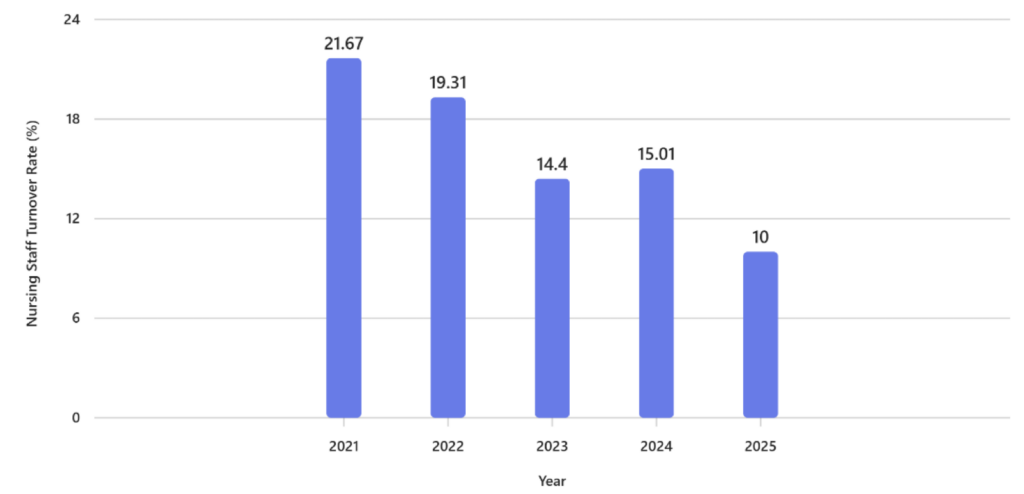
Hospitals across the country experienced unusually high turnover during the COVID-19 pandemic. Nationwide Children’s has worked diligently to address this concern and as a result we’ve seen significant improvement in nursing staff turnover. In fact, our nursing staff turnover rate has steadily decreased over the past five years.
One of the ways we’ve been able to retain nursing staff is by offering robust career development opportunities. Nursing staff at Nationwide Children’s have opportunities to leave one unit to go to another unit or apply their practice in a different area of the hospital all together. We believe we have the very best nursing staff and are committed to growing our own.
The chart below shows nursing staff turnover rates at Nationwide Children’s over the past five years. Nursing turnover among our Children’s Hospital comparators is around 13% for staff RNs.
Safety
Are nurse staffing ratios at Nationwide Children’s adequate to ensure safe working conditions?
Yes. Based on the data available to us through the Children’s Hospital Association, our staffing in nearly half of our units is within the top 20% nationally. While this data cannot provide for perfect apples-to-apples comparisons, most of our other units have staffing levels in the top 40% nationally.
What is Nationwide Children’s doing to ensure workplace safety?
Employee safety is a top priority. We have invested in training for staff and additional protective services resources, including adding armed officers and metal detectors.
Our protective services department announced that these changes will not be the last upgrades made to Nationwide Children’s security to improve employee safety.
Strikes
Would the union ask me to go on strike during negotiations?
Unions have the right to strike or picket during an organizing campaign or during negotiations. During a strike, striking workers receive no pay from their employer. And some unions can even fine members for not participating in the strike or crossing a picket line to go to work.
In the event of a work stoppage, Nationwide Children’s will take the proper steps to ensure a continuation of care our patients and families have come to expect from us.